

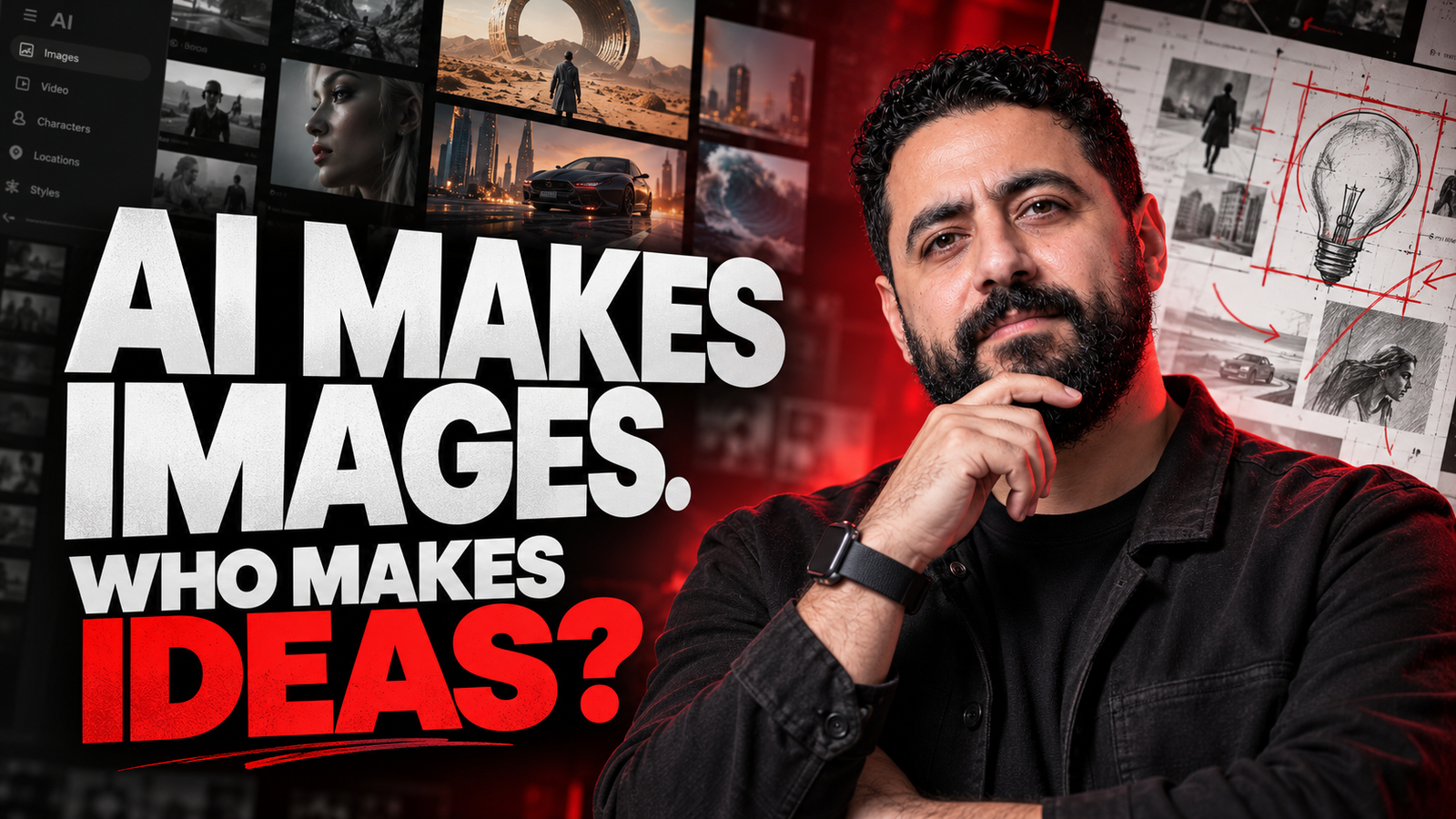
Why Creative Direction Matters More in the Age of AI
By Ahmed Ramlawy | Creative Director
The image looks expensive. The lighting is beautiful. The composition is balanced. The product sits exactly where it should. There is enough detail to convince someone that a production team spent days building it.
And yet, something is missing. Ask what the image is trying to communicate and the room goes quiet.
This is becoming one of the most interesting challenges in creative work. We have reached a point where producing a polished visual can be remarkably easy. Producing a meaningful one still requires something else: judgment.
A Beautiful Image Is Not Necessarily a Good Idea
Imagine two advertisements for the same laptop. The first shows the product floating above a futuristic city, surrounded by dramatic light, particles and metallic textures. It looks like a blockbuster poster.
The second shows someone at a kitchen table, working late because a project finally makes sense. Their laptop is open, the room is quiet, and there is a small expression of relief on their face.
Which one is better? There is no universal answer. But there is a better question: What is the brand trying to make people feel, understand or do?
If the message is about technical performance, the futuristic image might be right. If the brand wants to communicate how technology makes difficult work feel easier, the second image may have more potential. Creative direction begins with understanding that difference.
What AI Changed — and What It Didn’t
AI has changed the economics and accessibility of visual production. A designer can explore environments that would previously have required extensive production resources. A filmmaker can visualize a sequence before committing to a shoot. A creative team can test multiple directions without developing every idea into a full campaign.
Those are meaningful capabilities. But faster execution also introduces a temptation: to judge an idea by how convincing its execution looks.
A convincing image can make a weak concept seem ready. The danger is not necessarily that the work looks artificial. It is that the work looks finished before anyone has challenged the thinking behind it.
Creative Direction Is a Series of Decisions
People often associate creative direction with visual taste: choosing colors, composition, lighting, typography and references. Those decisions matter. They are simply not the entire job.
A creative director needs to understand the business problem before deciding what the audience should see. Who are we speaking to? What does that person already believe? What tension can the brand genuinely resolve? Why would someone remember this message tomorrow?
And perhaps the most uncomfortable question: if we removed the logo, could this advertisement belong to ten other brands?
These decisions shape the work long before the first image exists. AI can contribute to researching, exploring and visualizing possible answers. The responsibility for choosing and validating those answers remains with the people directing the work.
The Problem With Visual Sameness
Open enough AI image galleries and certain patterns become familiar: the immaculate product floating against a dramatic background; the cinematic portrait with colored rim lighting; impossible architecture; perfectly symmetrical composition.
None of these techniques is inherently wrong. They become a problem when the same visual language is applied to completely different brands and audiences.
A bank, a technology retailer and a fashion label should not automatically look as though they were directed by the same aesthetic preset.
Brand identity requires recognizable decisions made repeatedly over time. It also requires knowing when to resist an attractive visual because it does not belong to the brand. That restraint is part of creative direction.
Start With a Human Moment
Before writing a visual-generation prompt, try describing the situation your audience recognizes. Not the camera. Not the lens. Not the color grade. The situation.
A parent realizing they have forgotten something important before the school term starts. A customer who has spent an entire evening comparing devices and still cannot decide. Someone whose appliance stops working at the worst possible moment.
These situations contain the beginnings of stories because they contain people, pressures and recognizable behavior.
The technology enters after we understand the moment. It can help us build the world, explore visual treatments and bring difficult scenes to life. But it should not become a substitute for discovering what matters to the audience.
A Practical Test Before Approving AI-Generated Creative
When reviewing an AI-assisted campaign, I would use five questions:
1. Can we explain the idea without describing the visuals?
If the concept only works when we talk about lighting, rendering or cinematic effects, the underlying idea may need more work.
2. Is there a recognizable human insight?
The audience should find something familiar, useful, surprising or emotionally true.
3. Does the brand have a credible role?
The product or service should contribute naturally rather than appear as a logo attached to an unrelated spectacle.
4. Could the work belong to a competitor?
If the answer is yes, we need to investigate what makes this execution distinctive.
5. What will we measure?
Attention, recall, qualified engagement and commercial behavior answer different questions. A visually impressive result is not proof of advertising effectiveness.
The New Advantage Is Knowing What to Reject
When producing ten visual options was expensive, generating more work could be considered a competitive advantage. Now, producing options is increasingly accessible. The harder task is choosing.
Which concept deserves production? Which image serves the message? Which execution makes a brand more recognizable? Which beautiful idea should be discarded because it communicates nothing?
These are creative decisions. The people who develop this judgment, alongside a serious understanding of AI tools, will be better positioned to produce work that has both speed and purpose.
AI gives us more ways to make things. Creative direction gives us a reason to make them.
Read this article in Arabic.
About the author
Ahmed Ramlawy is a Creative Director working across branding, advertising, marketing and AI-enabled creative production.