

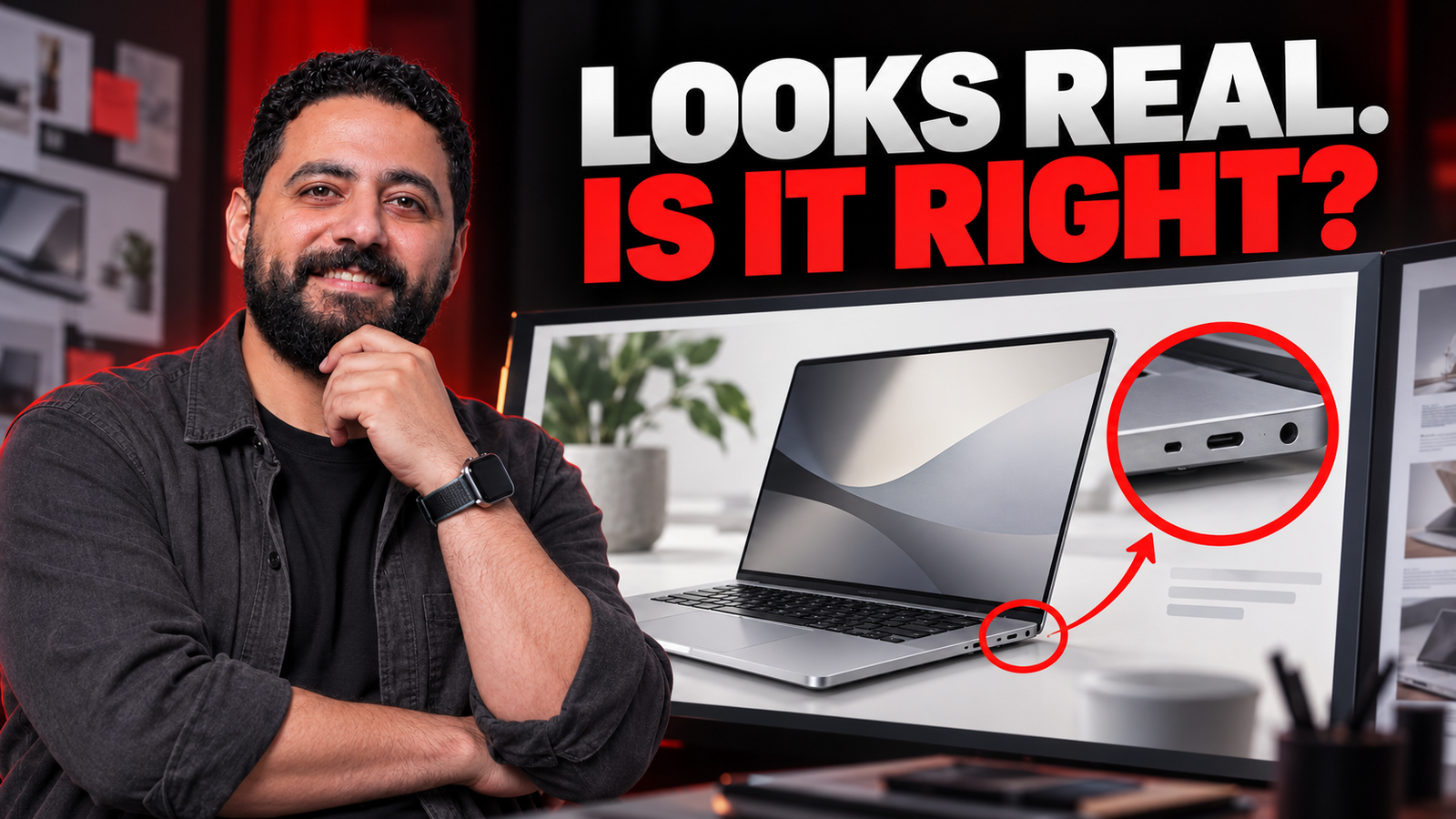
Why creative direction in AI advertising must protect product accuracy as carefully as visual quality.
By Ahmed Ramlawy | Creative Director
Imagine reviewing a beautifully produced advertisement for a laptop. The lighting is excellent. The materials look realistic. The camera movement feels expensive. There’s a convincing reflection across the aluminum surface, and the product looks like something you could reach out and touch.
Then someone from the product team notices something. The laptop has two USB-C ports. The actual model being advertised has one. Suddenly, the most convincing shot in the campaign becomes the one that needs to be replaced.
This is a hypothetical example, but it illustrates a real responsibility in AI-assisted advertising production. We can now create product visuals that look remarkably believable. The question is whether everything we’re showing deserves to be believed.
The Difference Between Looking Real and Being Accurate
For years, commercial production has used techniques to make products look their best. Lighting, photography, retouching, 3D rendering, compositing, and visual effects have always been part of advertising. Generative AI expands those possibilities.
We can explore environments, create cinematic situations, test camera angles, and develop visual directions without physically producing every element. That freedom is valuable.
But there’s an important distinction between improving how a product is presented and changing what the product actually is.
Imagine an AI-generated advertisement for a television. The image looks technically impressive. But the screen borders are thinner than those of the advertised model. Or consider a smartphone advertisement where an additional camera lens appears. A washing machine could be shown with controls that don’t exist. A laptop might have a different keyboard layout or display configuration.
These details can be easy to miss when everyone is concentrating on the overall composition. They also matter to someone considering a purchase.
The UK’s Advertising Standards Authority has emphasized in its guidance that misleading imagery can create an inaccurate impression of what consumers will receive, even without an explicitly false written claim.
AI doesn’t create the responsibility to represent products accurately. It makes that responsibility easier to overlook.
A Product Reference Is Not Just Visual Inspiration
There’s a habit in creative production that becomes particularly risky when working with AI. We provide a product reference, then ask the system to create a more dramatic version of the image. Better lighting. A different environment. A more cinematic angle. A premium product finish.
Most of those requests are reasonable. The problem begins when the product reference is treated as something the system can reinterpret.
For a conceptual campaign, visual interpretation can be part of the creative language. For an advertisement selling a specific product, it has limits.
The camera angle can change. The environment can change. The lighting can change. But the product’s physical characteristics must remain accurate wherever those characteristics are relevant to the buying decision.
This is where a production brief needs to become more precise than a general image-generation prompt. It needs to distinguish between two categories: what the creative team can change, and what the creative team must protect.
The Product Truth Lock
One practical framework I’d recommend is something I call the Product Truth Lock. It isn’t an AI feature or an industry standard. It’s a proposed production discipline: identify the information that must remain accurate before generating the creative execution.
| Area | Must remain accurate | Creative flexibility |
|---|---|---|
| Product identity | Correct model, variant, physical features, ports, controls, and color | Camera angle, framing, environment |
| Commercial information | Approved price, offer, currency, applicable terms, and included items | Typography, information hierarchy, layout |
| Product capabilities | Demonstrable features, supported performance, compatibility | Storytelling, pacing, visual treatment |
| Brand identity | Approved logo, packaging, essential brand assets | Composition, atmosphere, supporting graphics |
The important thing is agreeing on these boundaries before production. A creative team should know which elements can be explored freely and which require approval against an authoritative reference. That reduces ambiguity.
It also changes how we review AI-generated work. Instead of asking only whether the image looks convincing, we start asking whether it accurately represents what the customer can purchase.
The Product Team Needs to Be Part of the Creative Process
One of the difficult realities of retail advertising is that the people creating the campaign don’t necessarily own the product information. The designer understands the composition. The motion designer understands the animation. The Creative Director understands the overall concept and visual direction. But another team may be responsible for product specifications, prices, available variants, and promotional conditions.
If those groups aren’t connected, the creative production can move forward with incomplete information. That’s risky whether the advertisement is made with AI, photography, or 3D. With AI production, I’d argue that the connection needs to happen even earlier.
Before generating a product-led execution, the team should have access to an approved product reference. Not a random product photograph from an online search. Not an outdated render from an earlier campaign. An identifiable reference for the exact item being advertised.
For consumer electronics, that could include the approved model identifier, correct product images, visible physical characteristics, color and storage variants, and relevant specifications.
The goal isn’t to turn the creative department into a technical support team. It’s to avoid asking creative people to make product decisions they aren’t equipped or authorized to make.
Not Every Detail Has the Same Risk
Consider two changes in an AI-generated advertisement. In the first, the system makes the background wall slightly darker than requested. In the second, it changes the number of lenses on a smartphone.
Both are technically deviations from the prompt. But they shouldn’t be treated as equally important. The first may be an art-direction adjustment. The second may change the product being represented.
Creative teams need room to explore. But that freedom shouldn’t extend to factual product details. I’d prioritize review according to the potential impact on the customer.
Does the change suggest the product includes something it doesn’t? Does it exaggerate a capability? Does it show the wrong model? Does it create confusion about price or included accessories?
If the answer is yes, the issue should be resolved before the execution is approved. The more realistic the image becomes, the less likely a viewer is to interpret an inaccurate detail as artistic license.
Why an AI Label Isn’t Enough
One possible response is to disclose that the advertisement was created using artificial intelligence. Disclosure can matter, depending on the content, placement, audience, and applicable requirements. But disclosure and accuracy solve different problems.
An AI label may tell someone something about how the image was created. It doesn’t necessarily tell them which parts of the advertised product are inaccurate. Advertising guidance makes a similar distinction: disclosure of AI use is not a reliable remedy for a fundamentally misleading advertising message.
The same distinction applies to content provenance. Content Credentials can help establish information about how an asset was created or modified. But the C2PA specification distinguishes provenance verification from factual truth.
For creative teams, that means technical transparency shouldn’t replace product verification. Both have their place.
When the Better Creative Decision Is Not to Generate the Product
Sometimes the safest and most effective production decision is to stop trying to recreate the product entirely with AI. That doesn’t mean abandoning AI production. It means choosing a more suitable production method.
Related case study: eXtra Back to School 2026 — AI & 3D Production.
For example, an advertisement could use a manufacturer-approved product image as the hero asset while generating the surrounding environment. Or a verified 3D product model could be composited into an AI-assisted scene.
The atmosphere, background, lighting references, and storytelling could still benefit from generative tools. But the actual product would remain tied to a trusted source.
This hybrid approach won’t be necessary for every campaign. And even a manufacturer-supplied asset needs checking against the correct variant. But it can be a sensible choice when small physical details are commercially important.
The objective should never be to use the maximum amount of AI. It should be to use the most appropriate production approach for the idea.
A More Useful Final Approval Process
There’s a point in creative production where a beautiful image starts to feel finished. The lighting is approved. The composition works. The client likes the result. Everyone wants to move on. That’s exactly when a different kind of review becomes valuable.
1. Creative approval
Does the work communicate the idea effectively? Is the visual treatment appropriate for the brand? Does the execution support the intended audience and message?
2. Product and commercial approval
Is the exact product represented correctly? Are the specifications and claims accurate? Does the offer match the approved commercial information?
3. Final production approval
Has anything changed during adaptation? Are the correct product assets being used in every format? Do the final Arabic and English executions preserve the same commercial meaning? Have any AI-assisted revisions altered previously approved product details?
A single general approval can hide too many assumptions. Separate review responsibilities make those assumptions more visible. This is a proposed workflow, not a claim that one process guarantees error-free advertising.
What Creative Direction Should Protect
A Creative Director’s responsibility is often described in visual terms. The idea. The art direction. The quality of the final execution. Those are essential.
But creative direction also involves deciding which compromises are acceptable. Sometimes a more dramatic camera angle isn’t worth losing an important product detail. Sometimes a beautiful AI render needs to be replaced by a verified product asset. Sometimes the production team needs to slow down long enough to confirm exactly what is being advertised.
These decisions might not make the final film more visually impressive. They can make it more dependable. And dependable creative work is important when people are making purchasing decisions based on what we show them.
AI gives creative teams enormous freedom to imagine. Our responsibility is to know where that freedom must stop.
The camera can invent a world around the product. It shouldn’t invent the product itself.
Ahmed Ramlawy
Creative Director | Branding, Advertising & Creative Technology
Related reading: Why AI Content Needs a Brand System and I Don’t Just Use Tools. I Build the Ones I Need.